
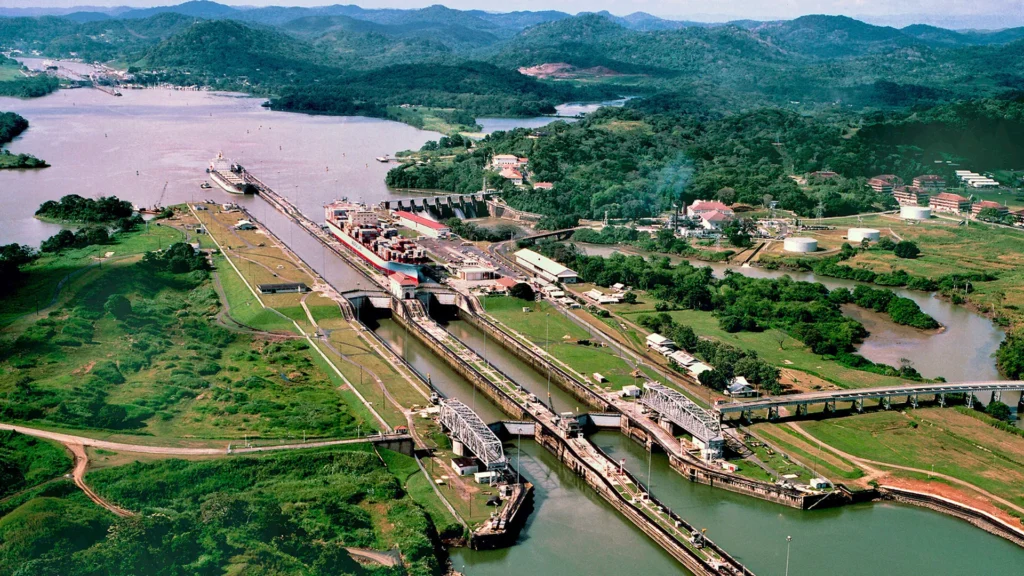
The Panama Canal Authority (ACP) is proactively lowering the draft limit to 49.5 feet starting July 3, 2026, to conserve freshwater, raising concerns about a new disruption to the supply chain.
PANAMA – The global maritime supply chain has just received its first warning signal as the Panama Canal Authority (ACP) officially announced the first operational restriction measure of 2026.
Specifically, starting July 3, 2026, the maximum draft limit for large Neo-Panamax ships passing through the expanded lock system will be reduced from 50 feet (15.24 m) to 49.5 feet (15.09 m), according to the Tropical Freshwater Flow (TFW) standard.
This decision marks a swift reversal from the ACP, as just weeks earlier (May 18th), the agency had stated it had no plans to restrict traffic flow due to stable, high water levels in Lake Gatun. Speaking at the Containers Don’t Lie Conference in Washington, Ricaurte Vásquez Morales, the Panama Canal Administrator, acknowledged that planners had to act earlier than usual to prepare for an El Niño scenario and prevent severe congestion similar to the historic drought of 2023-2024.
While the current 0.5-foot (~0.15 m) reduction in draft may not significantly impact most vessels currently operating, it reflects the ACP’s utmost caution in light of extreme weather forecasts.
The draft restriction comes at a time when shipping traffic through the canal is recovering strongly after the crisis. According to data from BIMCO, the number of ships transiting through the channel in 2026 increased by 8% compared to the same period, reaching an average of 38 voyages per day – approaching the channel’s maximum capacity (36 to 40 voyages/day). In particular, local conflicts in the Strait of Hormuz have caused a surge of 16% in the number of ships carrying crude oil, refined petroleum products, and LNG from the US to Asia via Panama in just five weeks leading up to mid-May.
However, this recovery is seriously threatened by meteorological reports. The National Oceanic and Atmospheric Administration (NOAA) Climate Prediction Center continues to monitor El Niño with alarming figures:
- There is an 82% probability that El Niño will form between May and July 2026.
- There is a 96% chance this phenomenon will last through the Northern Hemisphere winter (2026-2027).
- There is nearly a 66% chance that El Niño will reach strong to very strong intensity by the end of this year.
Currently, the Panama Canal handles approximately 5% of the total global maritime trade volume. The operation of this vital waterway depends entirely on freshwater from the two artificial lakes, Gatun and Alajuela – which both operate the lock system and supply drinking water to more than half of Panama’s population.
To prepare for the worst-case scenario, the ACP has activated a series of technological solutions since the end of 2025, such as: simultaneously closing the locks for small vessels, maximizing the use of water-saving reservoirs at the Neo-Panamax system, and temporarily suspending power generation at Lake Gatun to prioritize water storage.
ACP affirmed that it will continue to closely monitor hydrological developments to make further operational adjustments, while warning the market to be prepared for scenarios of deeper restrictions if weather conditions worsen towards the end of the year.
