


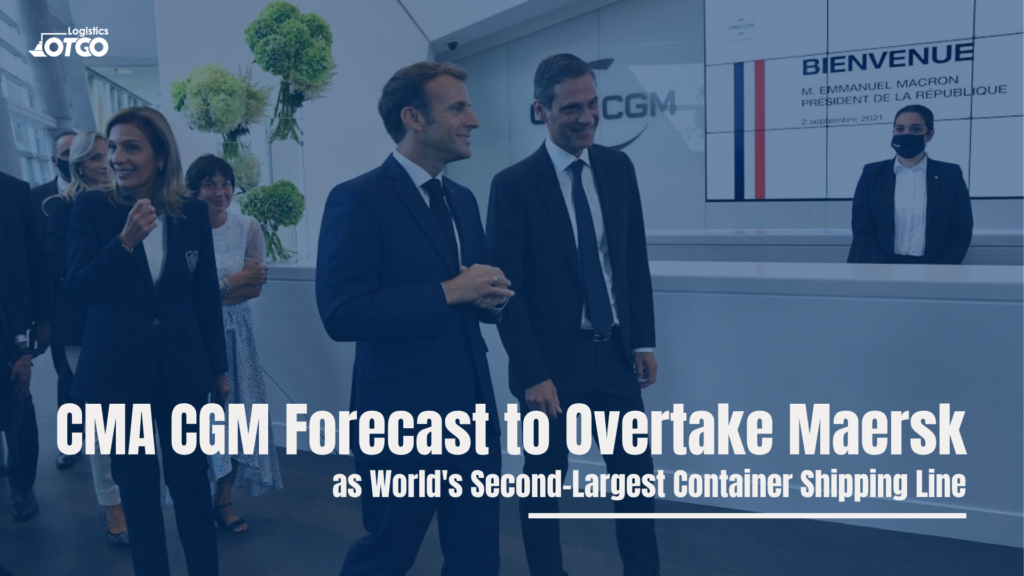
CMA CGM is projected to surpass Maersk to become the world’s second-largest container shipping line in 2027, as the gap in fleet capacity between the two carriers continues to narrow.
In an interview with French economic daily Les Echos last week, Rodolphe Saadé, Chairman and CEO of CMA CGM, said the Marseille-based carrier is on track to overtake Maersk within 18 months.

According to Saadé, CMA CGM could surpass Maersk by the end of 2027. However, data from Linerlytica suggests this milestone could arrive sooner — around July 2027. The gap in fleet capacity between CMA CGM and Maersk continues to shrink, reinforcing forecasts that CMA CGM will overtake Maersk to become the world’s second-largest container shipping line in 2027.
According to a report from Alphaliner, MSC is currently the world’s largest container shipping line with roughly 7.3 million TEU. Maersk ranks second with about 4.7 million TEU, while CMA CGM stands at approximately 4.4 million TEU. The gap between Maersk and CMA CGM is now only a few hundred thousand TEU of capacity, and CMA CGM’s newbuild orders are expected to narrow this gap further.
The major carriers are pursuing markedly different growth strategies. MSC has already built a significant lead over its rivals in container fleet capacity rankings. Maersk, meanwhile, is following a more cautious fleet expansion strategy while broadening its integrated logistics model. CMA CGM, by contrast, continues to expand its fleet capacity while investing heavily in ports, logistics, air freight, and inland transport.
Hua Joo Tan, founder of Linerlytica, said Maersk’s slip in the rankings is a consequence of its own strategic choice — sticking with its integrated logistics model — while rivals continue to capitalize efficiently on shipping-line profits.
The shift in rankings reflects more than just changes in fleet scale; it also signals broader shifts in the competitive landscape of the container shipping industry.
For decades, Maersk was seen as the industry benchmark for fleet size, network design, operational discipline, and strategic direction. Meanwhile, MSC has expanded its fleet significantly, and CMA CGM has used pandemic-era profits to expand into shipping, logistics, and media.
Alan Murphy, CEO of Sea-Intelligence, said Maersk has deliberately chosen not to defend its position at all costs, and is willing to accept slipping to third place if the cost of holding second place outweighs the benefit. Peter Sand, Head of Research at Xeneta, added that Maersk could face further pressure if COSCO manages to climb into third place in the future.
CMA CGM will also face risks as the container shipping industry heads into a new wave of vessel deliveries, with a large number of ships currently under construction set to enter the market. However, fleet capacity rankings do not reflect profitability, investment discipline, or the reliability of shipping schedules.
Amid continued growth in global capacity supply, Maersk is pursuing a lean-fleet strategy combined with logistics integration and network control, while CMA CGM is pursuing scale expansion, greater asset control, and a broader supply chain footprint.
